2013/09/10

Love Moon -Tsukimi-

At last, I’ve come to feel “autumn” these days, which makes me relieved after having scorching hot days. I think due to a clear and crisp air, the moon can be seen more beautifully around this season.

We love moon and take it very important because, I suppose, our predecessor lived with the waxing and waning of the moon. You may be surprised there are more than 100 ways to call the moon depending on its shapes.

As one example to show our love to the moon, there is a traditional event known as “tsukimi (moon-viewing)”, refers to Japanese festivals honoring the autumn moon. It takes place on August 15th and September 13th in the lunar calendar. (These days normally fall in September and October of the modern solar calendar.)

Traditionally, we made” tsutkimi- dango” (rice dumplings for the moon-viewing) and offered crops in season together with pampas grass, appreciating the rich harvest of the year and hoping for good crops in the coming year.

Nowadays, the way of observance has changed, and less people offer pampas grass and crops in season. But, we still appreciate the nature, enjoy viewing moon and eating "tsukimi-dango" with a nice cup of tea.


2013/09/05

Movie -ASK THIS OF RIKYU-

If you are a fan of traditional Japanese tea culture, I believe you know who “Sen no Rikyu” is.

He (1522-1591) is the most influential figure in the Japanese tea ceremony world. He became a tea master for Shogun then, Oda Nobunaga and Toyotomi Hideyoshi. Especially, at the era of Hideyoshi, he became one of closest confidants. However, in the end, Hideyoshi ordered him to do Seppuku (commit suicide) due to crucial differences of opinion and some other reasons which are unknown.


photo by T
What did the tea mean to Rikyu? What did the beauty mean to him? Were there any other real reasons that he had to commit suicide?

The film called “Rikyu ni Tazuneyo (Ask this of Rikyu)”, will be released this winter inJapan. I would love to watch it.


2013/08/24

Tea Seasoning -Chabasuco-

You know “Tabasuco”, don’t you ? Then, do you know “Chabasuco”?

Actually, I didn’t know that either. This is an unique seasoning , born in Yame (one of the biggest tea producing areas), using Yame tea, vinegar and pepper. Tea is “cha” in Japanese, so this seasoning is named “Chabasuko”, not Tabasuco. Ha, ha.

I hear this seasoning goes well with even vanilla ice cream. Interesting, doesn’t it?


*Chabasuko  photo
http://mainichi.jp/graph/2013/08/22/20130822k0000m040106000c/image/001.jpg

2013/08/19

Simple Recipe for Iced Tea

It is hot here, especially this summer. It is enervating.... I drink hot tea even summer, but also cold tea often sits in my fridge. My recipe to make iced green tea is very very simple.

1) Put 500ml of water and 5g of tea leaves into a container. (To be honest, prefering stronger tea, I use more tea leaves!)
2) Leave it for 3 – 5 hours or overnight in the fridge. When ready, take out tea leaves from the container. (Or, transfer tea into another container in order to separate from tea leaves.) This is it!

In my case, I’ve got a handy container with strainer. I usually prepare the iced tea before going to bed, and leave it in the fridge until the following morning. When I wake up, just take out the strainer and throw away the tea leaves.

handy container by T
Generally, Japanese tea has more amino acid called theanine (responsible for umami flavor), which is more extracted by using lower temperature hot water. Therefore, using “water” does make sense. You will enjoy gentle and sensitive flavor of Japanese green tea.


2013/08/18

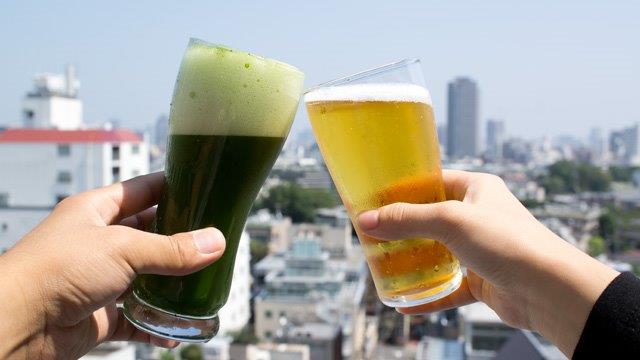
Matcha Beer

I haven’t tried this, but I heard some eatery places in Kyoto serve “Matcha beer”. I know Kyoto is far far away from your place. In that case, why don’t you make the beer at home? It seems that you can make it very easily.

Mix Matcha powder with water. Put it into a glass. Pour regular beer over its Matcha in the glass. That’s it. Enjoy!

frm webnews

2013/08/10

Chat with a Farmer over Tea

The other day, a farmer I know contacted me, saying “Would you taste and comment on what I produced?” Why not?! Since I would love to share the tea with others, I arranged a small Wakocha tasting gathering at a tea shop in Osaka. The farmer also joined the gathering and brought four Wakocha made from different varieties respectively: Benifuki, Sofu, Okumidori and Kijumidori. Of course, each variety has its own character - Benkfuki has a relatively good body, and Sofu has a distinctive aroma and a light body- , which makes Wakocha more interesting.Thanks to the farmer’s presence, we talked a lot including how the tea is grown and produced, and their characters etc. It helped stimulate the customers’ interest and curiosity more about tea.

Luckily (or not!?), some attendees were outspoken, making not only favorable comments but necessary points in order to improve the quality, which gave the farmer some hints to produce better quality tea. It was a beneficial and fun gathering for all. Amid decreasing the tea consumption in Japan, “face-to-face chat over the tea” could support tea culture.


Four kinds of Wakocha tea leaves   -by T-
                   

2013/08/01

Kyusu -teapot-

Japanese tea pot is called kyusu. “Kyu” literally means "surprise" and  "su" does "use". So it refers to a thing which is used on a surprise occasion.

In old days, kyusu would be used to warm sake in China, coming to be for tea as it is now.

In the past, having a surprise guest, people must have served tea (could be sake earlier) made with kyusu. Nowadays, less people use kyusu unfortunately. When a surprise guest is paid a visit, tea might be served from a bottle. :-(


variety of Kyusu   by T


Sakura Season

  Sakura is a feast for the eyes. Also a feast for the palate. Sencha named "sakura-hime (lit: sakura princess), which is blended with ...